
Event: 8 February 2026
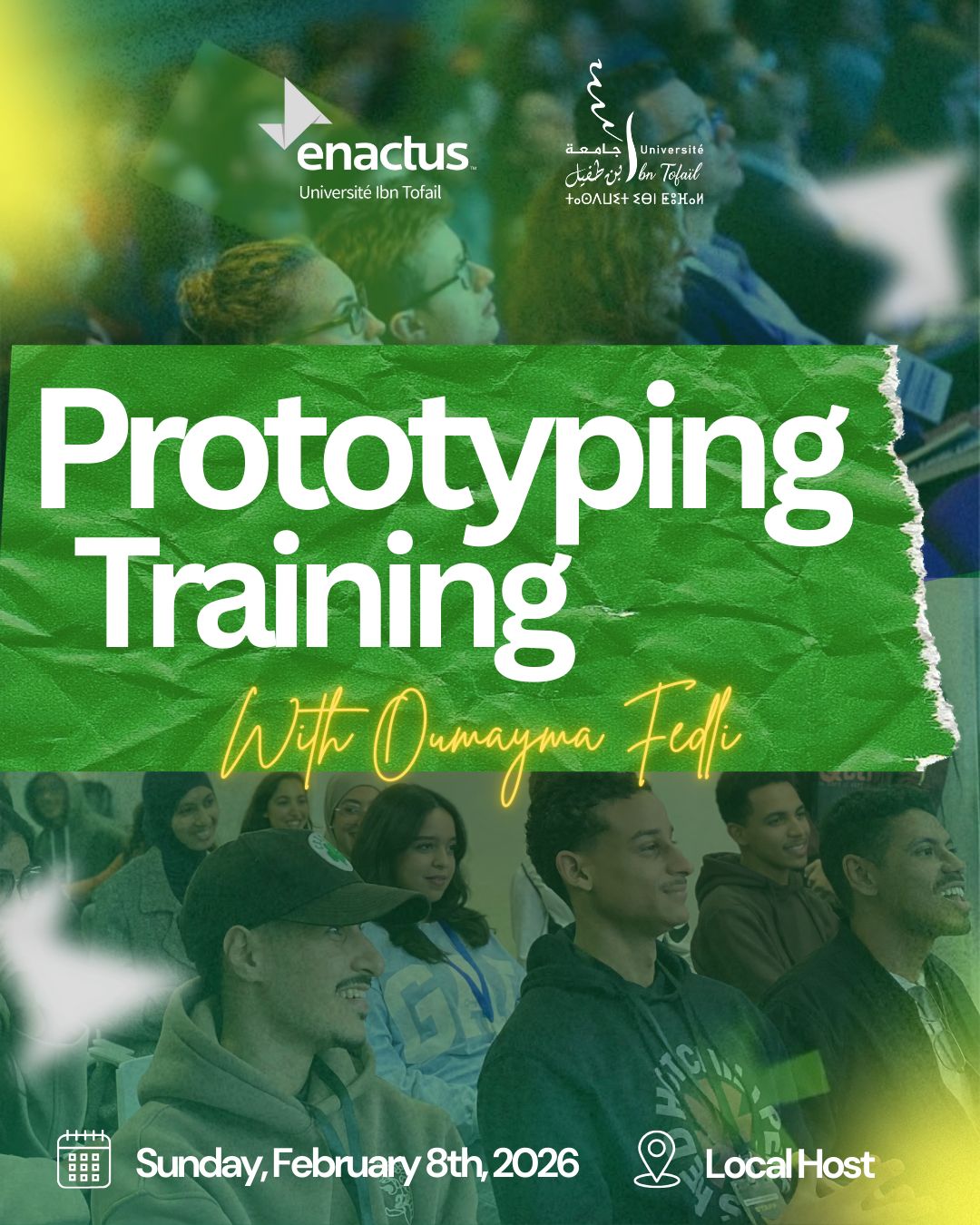
A promising idea is only the beginning of a project. Before time and resources are committed to developing a complete solution, the idea needs to take a form that can be examined in practice. This was the focus of the Prototyping Training organized by Enactus Ibn Tofail University on February 8, 2026, for its members. The session, delivered by Oumayma Fedli, introduced prototyping as a practical step between conceiving a solution and developing it further.
The training addressed the fundamentals of prototyping and the role this process plays in project development. Participants were introduced to the principle that an initial idea does not need to become a finished product immediately. Instead, it can first be represented in a tangible and testable form, allowing the project team to explore how the proposed solution could work before moving to a more advanced stage.
This approach changes the way a project idea is considered. Rather than concentrating only on what a solution is expected to achieve, prototyping brings attention to how the idea can function in practice. It creates an opportunity to examine a concept through experimentation and to identify aspects that require further development. The training therefore placed creativity, experimentation and practical thinking at the centre of the project-development process.
For Enactus members, this distinction is particularly relevant. Student entrepreneurial projects begin with identified needs and proposed responses, but moving from a problem to a workable solution requires more than generating an idea. Understanding the role of prototyping provides members with a way to approach that transition more systematically: first by making the concept sufficiently concrete to be tested, and then by using what is learned from that practical examination to inform subsequent development.
The session also introduced a different relationship with early project ideas. A first concept does not have to be treated as a final answer. Testing becomes part of development rather than something reserved for the end of the process. This perspective supports a learning-by-doing approach in which experimentation helps project teams examine their assumptions before advancing further with a proposed solution.
Prototyping already has a place within the broader Enactus project-development environment. Previous capacity-building experiences involving Enactus UIT members have addressed concepts such as proof of concept, minimum viable product, user testing, and iterative improvement. While these specific methods are not documented as components of the February 8 session, they illustrate the wider project-development framework in which prototyping can help move an idea progressively towards application.
The value of the training therefore extended beyond learning the meaning of prototyping. It introduced members to a way of approaching project development in which ideas are made testable before they are treated as established solutions. For students working on entrepreneurial and impact-oriented initiatives, this means connecting creativity with practical examination and making project development a process informed by what can be observed and tested.
Through this training, Enactus Ibn Tofail University strengthened the practical learning opportunities available to its members. By focusing on the stage between an initial idea and its further development, the activity contributed to skills relevant to student entrepreneurship, project design, and applied problem-solving, while reinforcing the role of learning through practice within student-led initiatives at Ibn Tofail University.