Event: 18 June 2026
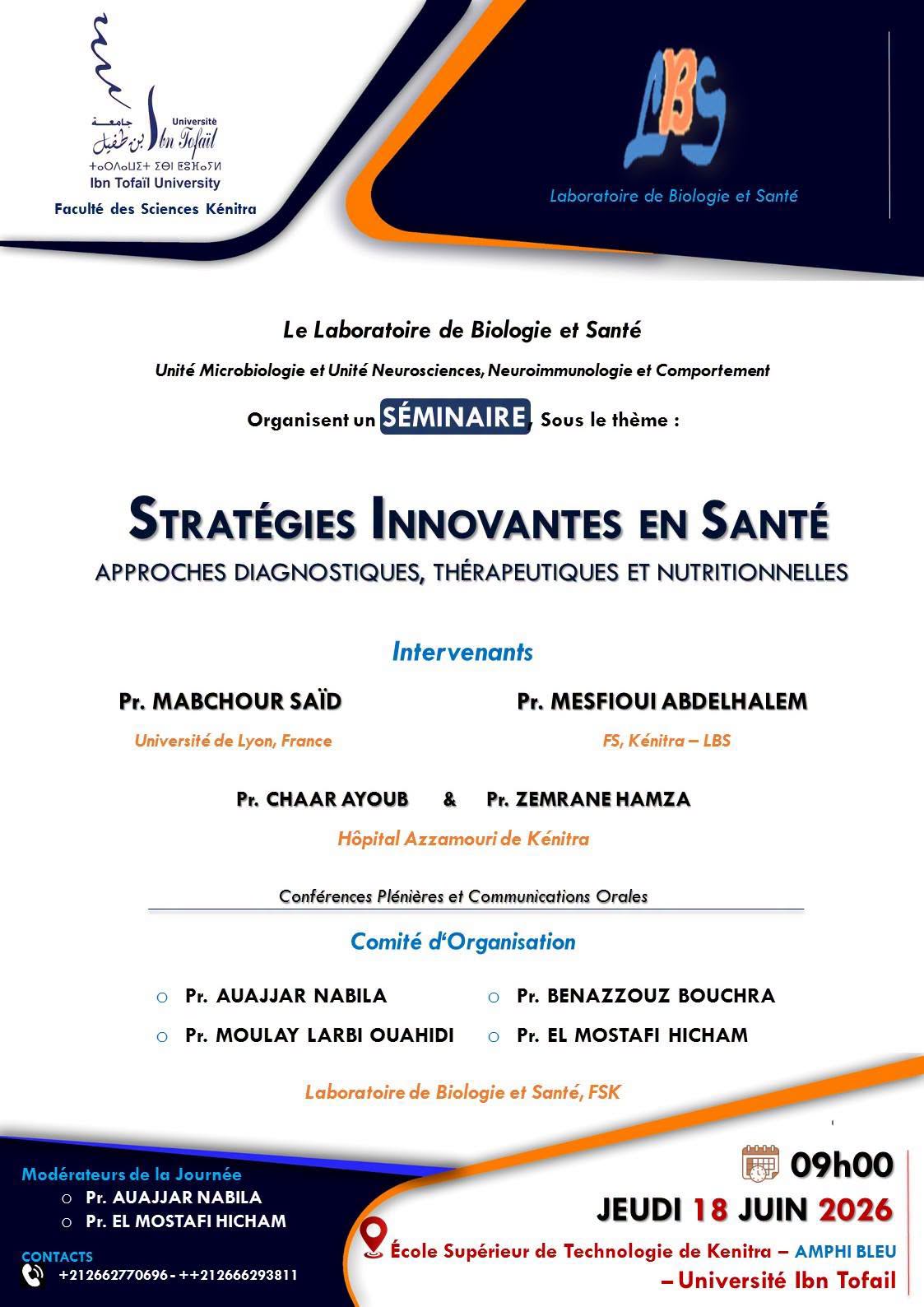
A health challenge rarely belongs to a single discipline, and neither does its solution. From bacterial activity and neuroinflammation to genomics, artificial intelligence and bedside imaging, progress often emerges when different fields meet. This idea shaped the scientific seminar “Innovative Strategies in Health: Diagnostic, Therapeutic and Nutritional Approaches,” held at Ibn Tofail University on 18 June 2026.
Organized by the Laboratory of Biology and Health (LBS) at the Faculty of Sciences, through its Microbiology Unit and Neurosciences, Neuroimmunology and Behaviour Unit, the seminar took place at the Higher School of Technology of Kenitra, Blue Amphitheatre. The programme included contributions from Ibn Tofail University researchers alongside speakers identified with the University of Lyon, France, and Azzamouri Hospital in Kenitra, combining research and clinical perspectives.
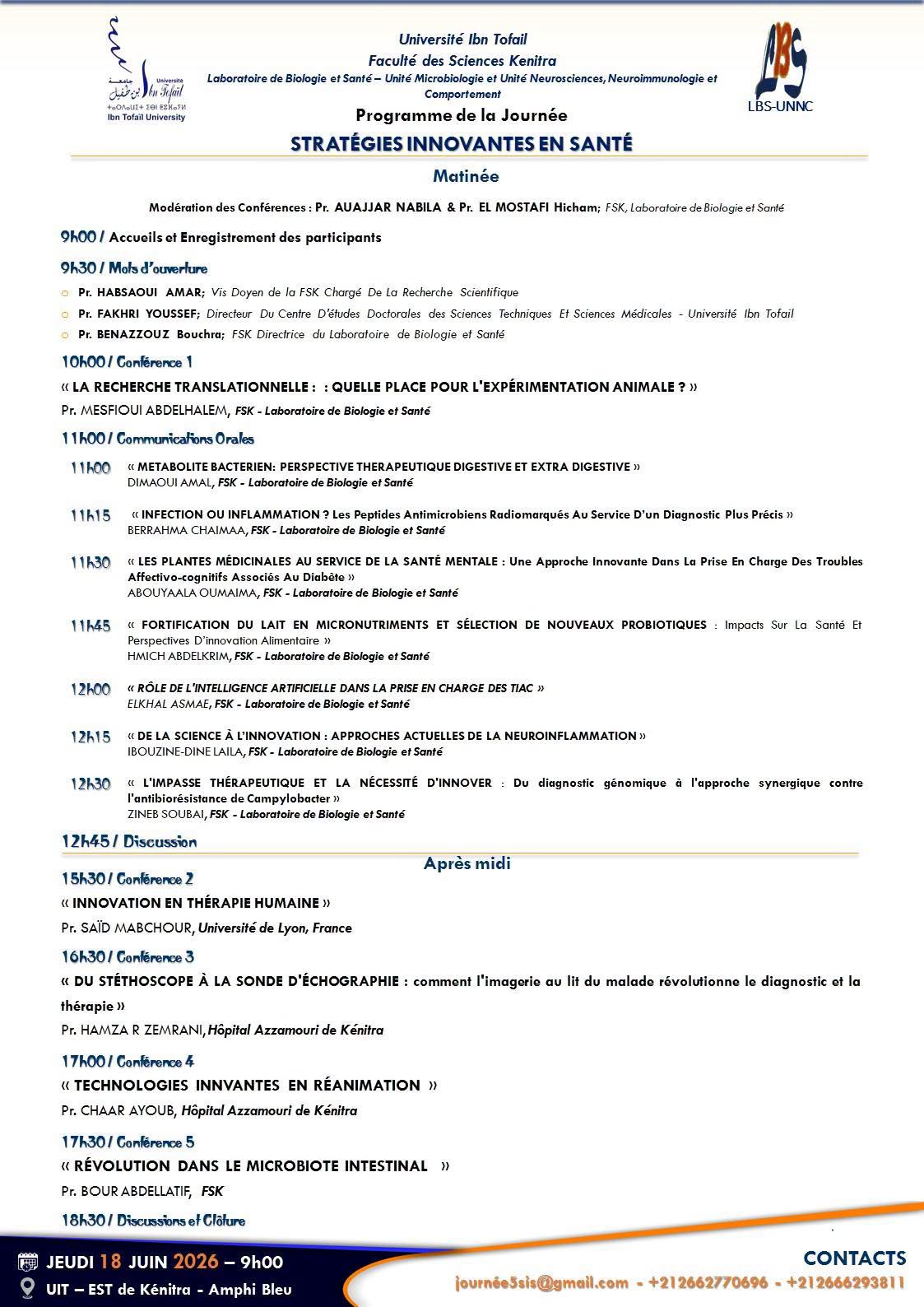
The programme began with Prof. Abdelhalem Mesfioui, who examined the role of animal experimentation in translational research, an approach that seeks to connect experimental findings with potential applications in human health. The oral communications that followed explored health innovation from several angles. Diagnostic research included radiolabelled antimicrobial peptides to distinguish infection from inflammation and genomic approaches to Campylobacter antimicrobial resistance. Therapeutic research addressed bacterial metabolites, medicinal plants, and neuroinflammation, while nutrition-related topics covered micronutrient fortification and the selection of new probiotics. The programme also examined the use of artificial intelligence in the management of foodborne illnesses.
The afternoon moved from experimental and biological research towards therapeutic and clinical applications. Prof. Saïd Mabchour, identified with the University of Lyon, addressed innovation in human therapy. At the clinical level, Prof. Hamza R. Zemrani of Azzamouri Hospital discussed how bedside ultrasound can support diagnosis and therapy, while Prof. Ayoub Chaar, also affiliated with the hospital, focused on innovative technologies in intensive care. Prof. Abdellatif Bour of the Faculty of Sciences completed the scientific programme with a presentation on the intestinal microbiota.
This progression from laboratory investigation to clinical practice gave the seminar its multidisciplinary character. Microbiology, neuroscience, nutrition, genomics, artificial intelligence, medical imaging and intensive care were approached not as isolated subjects, but as complementary areas within contemporary health research. Conferences, oral communications and discussion sessions provided a common setting for examining both established and specialized approaches, including translational research and radiolabelled antimicrobial peptides.
By connecting fundamental research with diagnostic, therapeutic, nutritional, and clinical perspectives, the seminar provided a focused setting for scientific exchange on current approaches to health research and innovation, while highlighting the value of bringing complementary fields together to address complex health questions.