Event : 13 November 2026
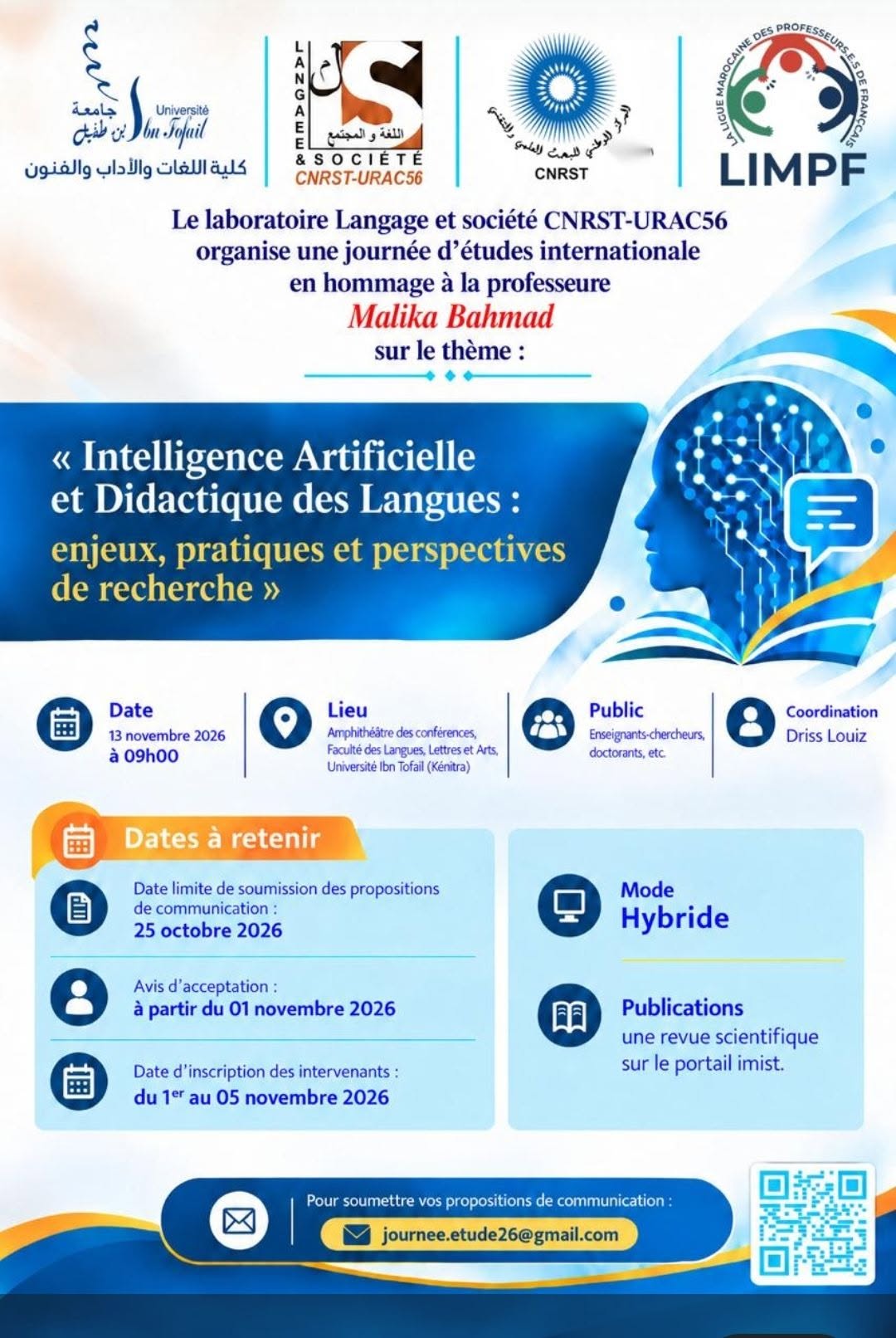
The Laboratory of Language and Society (URAC 56) at Ibn Tofaïl University organised an international study day on “Artificial Intelligence and Language Didactics: Challenges, Practices and Research Perspectives” on 13 November 2026 at the Faculty of Languages, Letters and Arts in Kénitra. The event was dedicated to paying tribute to Professor Malika Bahmad, professor at the Faculty of Languages Letters and Arts, former Director of the Language Centre at Ibn Tofaïl University and a member of the Laboratory of Language and Society, in recognition of her academic, scientific and institutional contributions. The study day was coordinated by Professor Driss Louiz.
Bringing together researchers, academics, doctoral students and specialists in language education, the event provided an opportunity to examine the growing role of artificial intelligence (AI) in language teaching and learning, as well as its implications for contemporary educational practices. It aimed to encourage scientific debate on the opportunities, challenges and emerging perspectives associated with integrating AI into language didactics, particularly in the context of digital transformation in higher education.
The scientific programme addressed five major themes: the reconfiguration of teaching approaches and digital literacy; the personalisation of learning and learner autonomy; the transformation of teachers’ roles and pedagogical engineering; the challenges of assessment in the age of AI; and the ethical, sociolinguistic and educational policy dimensions of artificial intelligence.
The programme featured expert-led conferences during the morning session, followed by scientific presentations and discussions in the afternoon. Organised in a hybrid format, the study day combined in-person and online participation, enabling researchers and academics from countries including Russia and France to take part in the scientific discussions. This international dimension enriched the exchange of knowledge, research findings and perspectives, while strengthening opportunities for cross-border academic interaction and collaboration.
Beyond its scientific objectives, the study day highlighted the importance of addressing the ethical and sociocultural implications of AI, including data sovereignty, cultural and linguistic diversity, equitable access to digital technologies, and the impact of AI on Moroccan and international educational contexts. It also emphasised the need to rethink teachers’ professional roles and develop pedagogical approaches that combine technological innovation with human expertise and critical reflection.
The event further provided a platform for disseminating scientific research, with selected contributions validated by the scientific committee intended for publication in a scientific journal available through the IMIST portal.
Through this international initiative, Ibn Tofaïl University reaffirms its commitment to scientific research, academic excellence and digital innovation, while promoting interdisciplinary dialogue and international academic cooperation. By bringing together specialists in artificial intelligence and language education, the university contributes to shaping innovative, responsible and inclusive approaches to teaching and learning in the digital age.