
Event : 12 November 2025
” Climate action may still feel like an option today, but tomorrow it will be an obligation. Every step we take now is a step we refuse to take too late. “
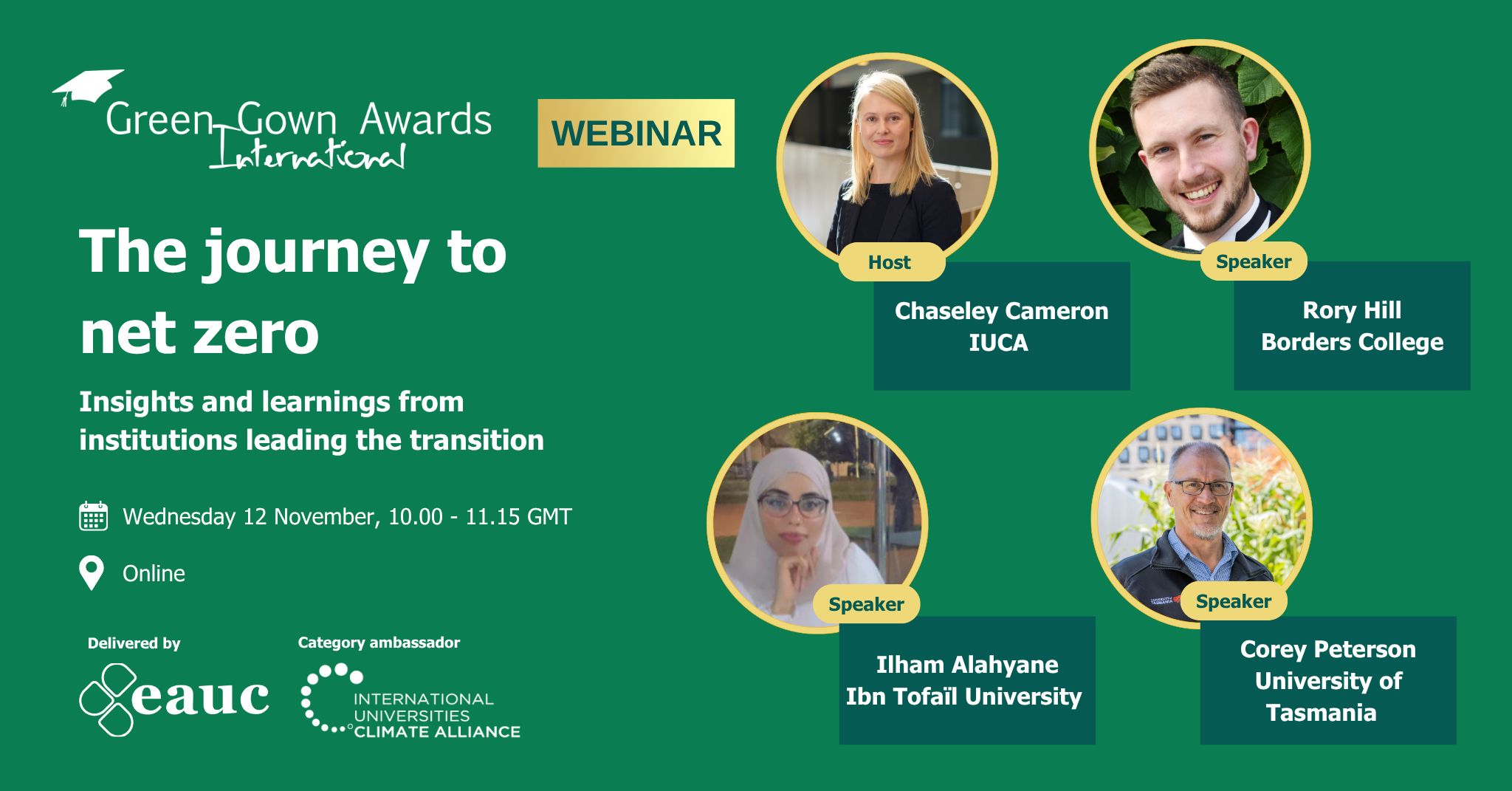
On 12 November 2025, Ibn Tofail University proudly represented Morocco during an online global webinar held for COP30 Education Day, dedicated to Net Zero & Climate Action. Co-hosted by the Environmental Association for Universities and Colleges (EAUC) and the International Universities Climate Alliance (IUCA), the event brought together climate leaders from across the world.. As one of the two global winners for the 2030 Climate Action category, standing proudly beside the University of Tasmania, Ibn Tofail University participated in a dynamic and forward-focused exchange. Together with Borders College, the discussion showcased how universities can reshape the climate landscape through innovation, leadership, and collective action.
Delivered entirely online, the webinar created a global space for reflection, collaboration, and sector-wide learning. Participants examined how universities can embed net zero across governance, operations, curricula, research, and community outreach. The session revisited a key question highlighted by University World News: How can universities become central agents of climate transformation? The virtual format amplified diversity of perspectives, reinforcing the importance of shared global responsibility.
Ibn Tofail University opened the panel with a clear and concise presentation of its net zero trajectory. UIT aligned its ambitions with Morocco’s national climate strategy and emphasized major achievements, including expanded solar installations, campus-wide LED retrofits, improved energy management systems, and strengthened governance structures. These milestones, achieved by a modest-sized institution, illustrate a deep commitment to responsible energy transition and operational sustainability.
UIT highlighted innovative initiatives underpinning its climate action program. Central among these is the Sidi Taïbi Hybrid Water & Energy Station, a flagship project that produces potable water for thousands of students using renewable solar-wind energy. This initiative directly addresses climate-induced water stress while reducing reliance on fossil-fuel-powered water systems. In parallel, the university’s smart-building technologies, energy-efficient infrastructure, and expanding solar capacity demonstrate how climate adaptation and mitigation can be integrated into campus development.
Responding to a key panel question, UIT emphasized that climate action must generate tangible social benefits. The Sidi Taïbi station was presented as a clear example: it provides clean water for students in an area historically affected by shortages, reduces financial burdens on vulnerable communities, and enhances local resilience. Similarly, university-wide energy savings have enabled the reinvestment of resources into student services and community-oriented projects. For UIT, sustainability is inseparable from social progress, making its climate agenda both environmental and human.
When addressing student engagement, the university highlighted that students are central actors in designing and sustaining climate initiatives. Through green clubs, climate challenges, applied research projects, field-based learning, and volunteering networks, students not only participate; they lead. UIT noted that sustaining motivation across changing cohorts requires flexibility, mentorship, and consistent opportunities for real-world impact. Despite its small size, the university has succeeded in creating a culture where students become climate ambassadors and innovators.
The online dialogue was enriched by the perspectives of the University of Tasmania, UIT’s fellow winner, and Borders College, a highly commended institution. Tasmania emphasized aligning institutional finances with climate goals, demonstrating how responsible investment and funding strategies are crucial for achieving climate ambition. Borders College presented its Joint Sustainability Partnership, a model showing how institutions can share resources and expertise to accelerate sustainability progress. These insights reinforced UIT’s belief that global collaboration is essential, especially for smaller institutions seeking to scale their impact.
The webinar concluded with a unified call for deeper, more inclusive, and more courageous climate action across the higher education sector. Ibn Tofail University reaffirmed its commitment to advancing its net-zero roadmap, strengthening community-based climate solutions, and expanding research-driven innovation. As a small institution achieving global recognition alongside a major university, UIT stands as an inspiring example of how determination, creativity, and social responsibility can drive climate impact. Through active participation in global networks, the university continues to contribute to a resilient, equitable, and sustainable future for Morocco, Africa, and the world.