
Date: October 25, 2025
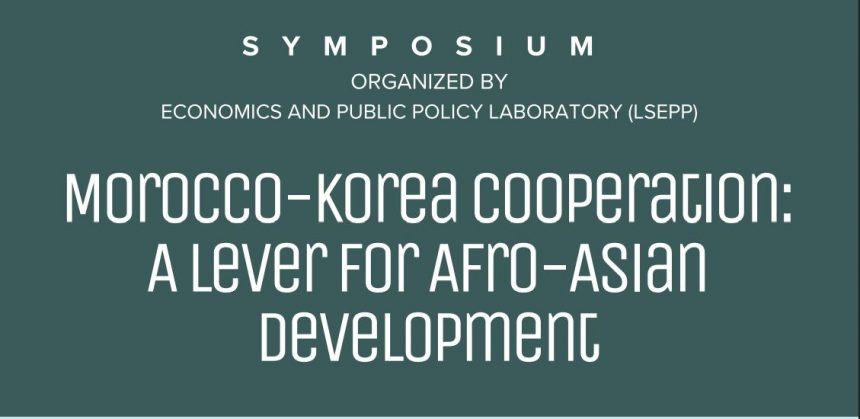
Some academic events inform. Others connect. A few succeed in doing both. The international symposium “Morocco–Korea Cooperation: A Lever for Afro-Asian Development,” held on October 25, 2025, belongs to the latter category. Hosted by the Faculty of Economics and Management and organized by the Economics and Public Policy Laboratory (LSEPP), the symposium transformed the university space into a place of encounter between regions, disciplines, and ways of thinking.
Rather than approaching cooperation as a theoretical ambition, the symposium treated it as an intellectual practice. From the opening session, the focus was clear: development gains meaning when it is examined through comparison, dialogue, and shared inquiry. The plenary discussions brought together Moroccan and Korean academic perspectives to reflect on public policy, governance, and international cooperation, not as parallel experiences, but as intersecting trajectories capable of enriching one another.
As the day unfolded, this spirit of exchange extended into a dense and carefully structured academic program. The afternoon sessions offered a wide-ranging exploration of issues shaping Afro-Asian development today. Scholars examined economic transitions, governance frameworks, innovation systems, competitiveness, education, health policies, and climate-related challenges through comparative lenses. What unified these discussions was not a single conclusion, but a shared method: understanding complexity by confronting difference.
The diversity of topics reflected a central conviction that development cannot be reduced to one sector or one model. Economic diplomacy was discussed alongside human capital formation; innovation and digital transformation were analyzed together with institutional governance; education and public health were considered as strategic pillars of long-term resilience. In this way, the symposium resisted simplification and instead embraced the layered realities of contemporary development paths.
Yet the value of the symposium did not reside solely in its academic density. It also lay in the quality of interaction it fostered. Presentations were followed by discussion, debate, and exchange, allowing ideas to circulate rather than remain confined to papers. Researchers, doctoral students, and senior academics engaged in a shared intellectual rhythm, where listening was as important as speaking. Cooperation, here, was not declared; it was practiced.
This human dimension gave the event its distinctive character. By bringing together scholars from different regions and academic traditions, the symposium highlighted the role of universities as spaces where global challenges can be approached collectively, without erasing context or difference. It reaffirmed that Afro-Asian cooperation is not built through uniformity, but through respectful engagement and mutual learning.
In hosting this symposium, the university reaffirmed its commitment to international academic openness and research-driven dialogue. The event demonstrated how higher education institutions contribute to development not only by producing knowledge, but by creating the conditions for ideas to meet, confront one another, and evolve.
As the symposium concluded, it left behind more than a program of sessions. It offered a shared understanding: when cooperation is grounded in research, dialogue, and human exchange, it becomes a durable lever for development. In a world often divided by difference, this academic encounter showed that difference, when approached through dialogue, can become a source of collective insight and shared progress.