

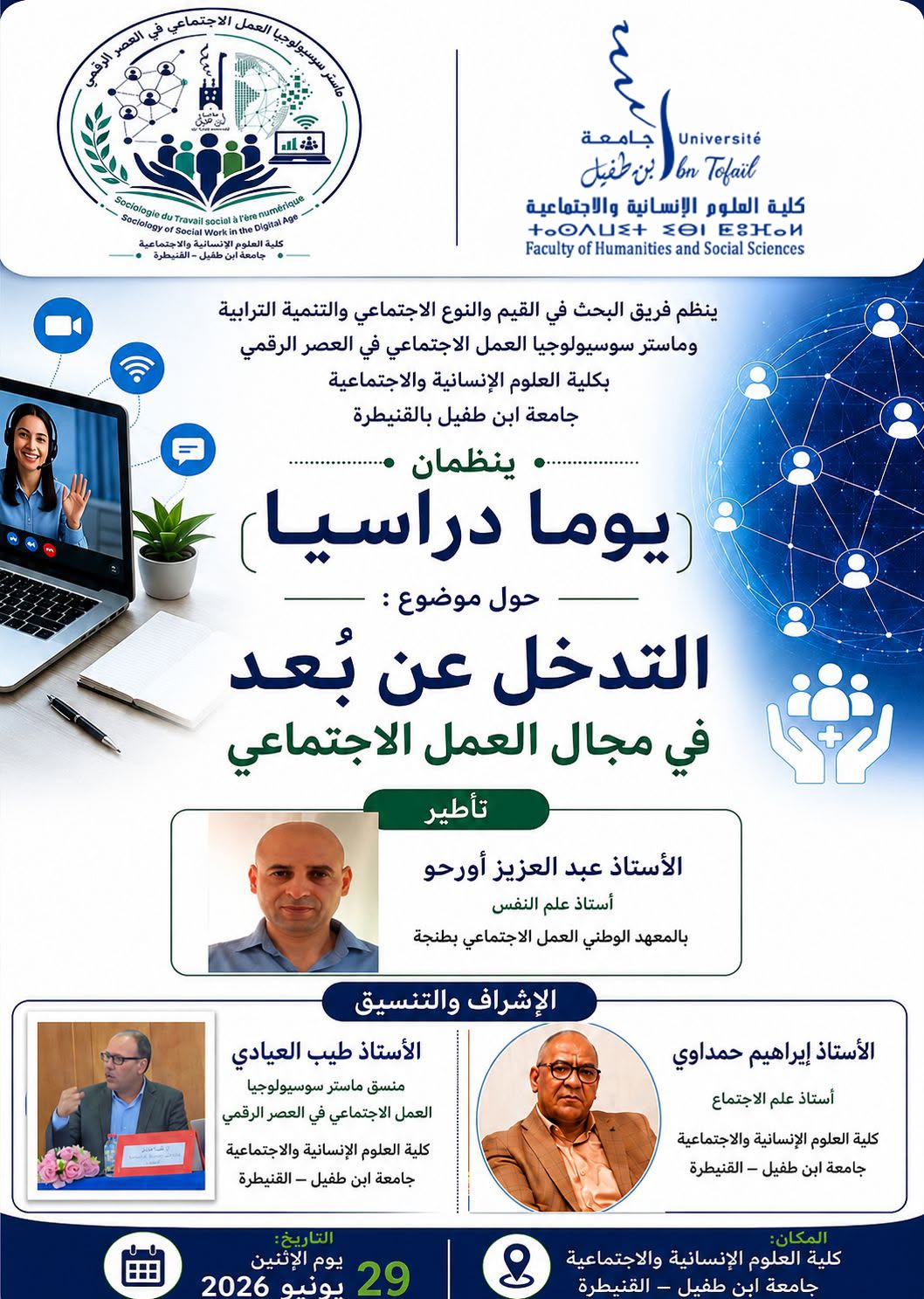
Event: 29 June 2026
Social work has traditionally been built around direct human contact. Yet support, guidance, and professional follow-up increasingly take place across screens and at a distance, raising a central question for the field: how can social intervention adapt when practitioner and beneficiary no longer share the same physical space? This changing reality formed the focus of a study day organized at Ibn Tofail University on 29 June 2026 under the theme “Remote Intervention in the Field of Social Work.”
Held at the Faculty of Humanities and Social Sciences in Kenitra, the study day was organized by the Research Team on Values, Social Diversity and Territorial Development and the Master’s programme in Sociology of Social Work in the Digital Age. The event was closely connected to the programme’s academic context, bringing a contemporary form of intervention into the training environment of students studying social work amid wider digital change.
The session was led by Prof. Abdelaaziz Ourhou, Professor of Psychology at the National Institute of Social Action (INAS) in Tangier. His academic profile includes work related to psychosocial intervention and social services, providing relevant expertise for examining the human dimensions of intervention at a distance. His affiliation with INAS and involvement in academic work on psychosocial intervention are independently documented. The study day was supervised and coordinated by Prof. Ibrahim Hamdaoui, Professor of Sociology at Ibn Tofail University, and Prof. Tayeb El Ayadi, coordinator of the Master’s programme.
The significance of the topic lies in a shift that extends beyond the simple use of digital tools. Remote intervention changes the setting in which social support can take place. Professional contact is no longer necessarily dependent on the practitioner and beneficiary being physically present in the same location. This opens a broader academic discussion around how communication, follow-up and professional relationships can function across distance, while also drawing attention to the conditions and limitations surrounding digitally mediated interaction.
For students of social work, this emerging context broadens the meaning of digital competence. The issue is not only how to use a communication platform, but how established approaches to intervention can be considered when interaction takes place remotely. Questions of accessibility, geographical distance, continuity of contact and the quality of human interaction consequently become part of understanding how social-work practice may evolve in digital environments.
This focus is particularly relevant to the Master’s in Sociology of Social Work in the Digital Age, an academic programme offered by the Faculty. By placing remote intervention within this training context, the study day connected sociological and psychological perspectives with a developing area of professional practice. It encouraged consideration of digitalization not as a separate technological phenomenon, but as a change that can influence how social services are conceived and delivered.
The study day thus addressed an evolving dimension of social work: physical distance does not necessarily have to mean the interruption of professional contact. Examining this possibility within university training helps future practitioners engage critically with new forms of intervention, their potential and their limits, while keeping the human relationship the foundation of social work at the centre of practice.