
A university campus is not defined only by its buildings, pathways, or green spaces, but by the way students experience them every day. It is defined by who can enter a classroom without hesitation, who can move independently, and who can fully belong. At Ibn Tofail University, the idea of a unified campus finds its true meaning in accessibility, inclusion, and shared humanity. A campus cannot be considered unified if some students must struggle simply to move within it. When access is unequal, education ceases to be a shared right and becomes an individual burden.
From this awareness emerged Campus for All, an initiative imagined, shaped, and carried forward by students of the National School of Business and Management (ENCG). This project was not born in theory or policy documents, but from lived experience. It grew from observation, empathy, and a quiet but powerful question: How can a campus be considered inclusive when not every student can access it?
Through the commitment of Ahlam Bel Hati, Oumaima Boughlem, Oumaima Benjelloun, Mohamed Amine El Garouani, Saad Bentaleb, Oumaima Abdessamad, Zakaria Bouzidi, and Imane Afifi, this idea became a reality. As students themselves, they did not look at accessibility from a distance. They looked at it from within, through the daily challenges faced by their peers with reduced mobility. Their response was simple, honest, and courageous: instead of asking students to adapt to barriers, they chose to remove the barriers.
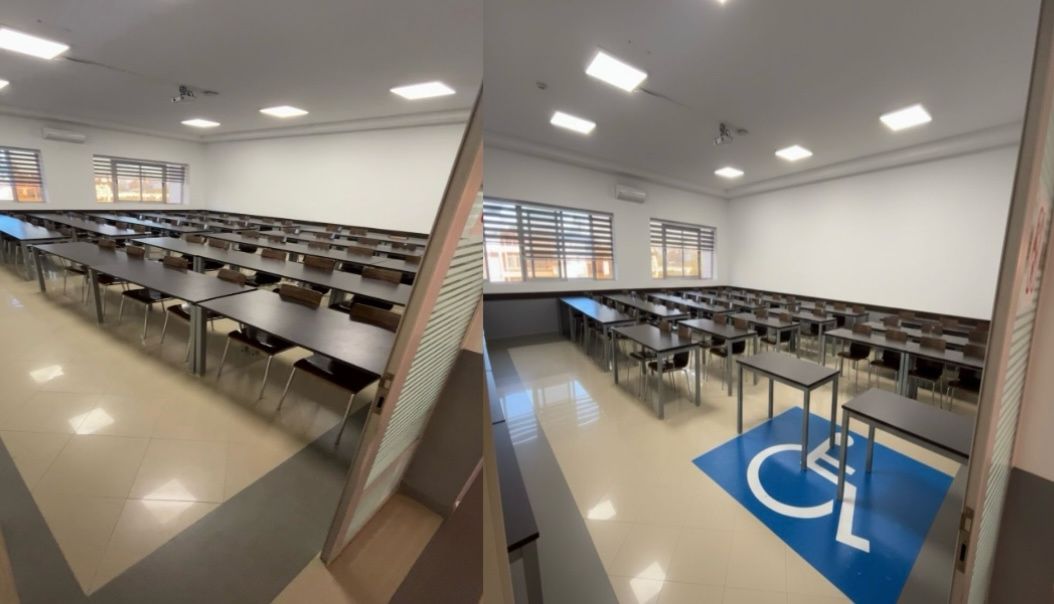
What makes this initiative remarkable is its clarity. It focuses on what truly matters. Access ramps that reconnect spaces. Sanitary facilities adapted with dignity in mind. Classrooms reorganized to allow autonomy rather than dependence. Circulation improved so movement becomes natural, not exhausting. These actions may appear simple, yet their impact is profound. They change how students arrive, how they stay, how they learn, and how they feel.
Beyond physical transformation, Campus for All reshapes the learning experience itself. When students no longer waste energy overcoming obstacles, they invest it in thinking, participating, and growing. Accessibility becomes a foundation for better education quality, not an additional feature. It creates calmer learning environments, stronger engagement, and equal opportunities to succeed.
This initiative also speaks to something deeper. By acting for one another, these students strengthened the social fabric of the university. They showed that inclusion is not an abstract value, but a daily practice. A campus that is accessible does more than support students with disabilities; it educates everyone. It nurtures empathy, responsibility, and awareness, shaping better students and more conscious citizens who understand that progress is a collective effort.
Supervised by Mme Fatima Zahra Moussaid and developed within the ENCG academic framework, Campus pour Tous (Campus for All) stands as a powerful example of student-driven change. It proves that universities are not only places of learning, but places where values are lived, tested, and transformed into action.
More than a project, this initiative is a message that says a campus belongs to everyone. By making accessibility real rather than optional, these students remind us that a truly unified campus is built through empathy, simplicity, and shared responsibility. And sometimes, the most meaningful change begins with students who choose to care for one another.