Event: 20 May 2026
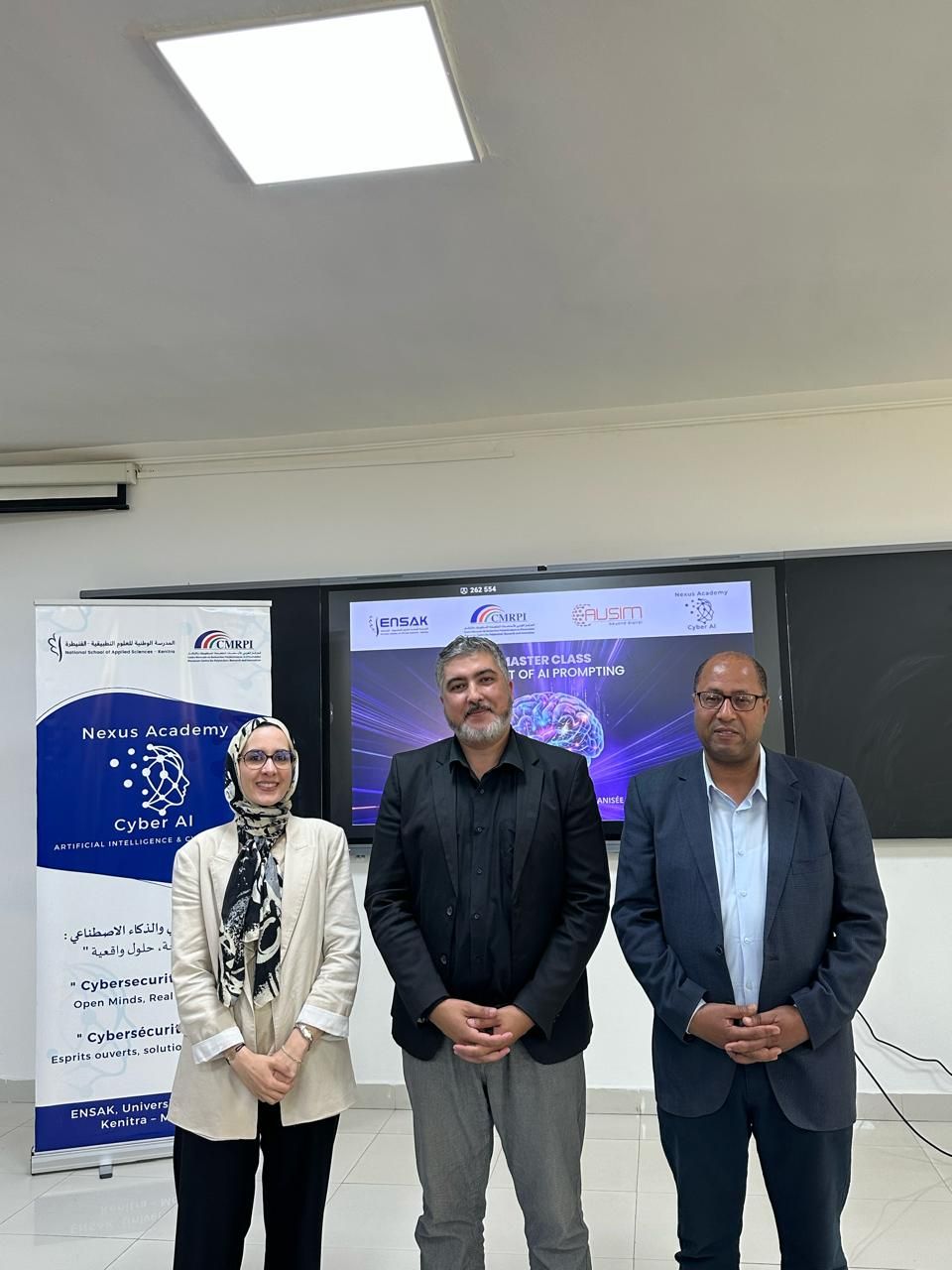
Generative artificial intelligence can produce an answer within seconds, but getting a useful response also depends on how clearly you communicate a task to the system. What should the model do? What information does it need? Can examples help clarify the expected result? These questions formed the practical starting point of “The Art of AI Prompting,” a masterclass held on 20 May 2026 at the National School of Applied Sciences of Ibn Tofail University.
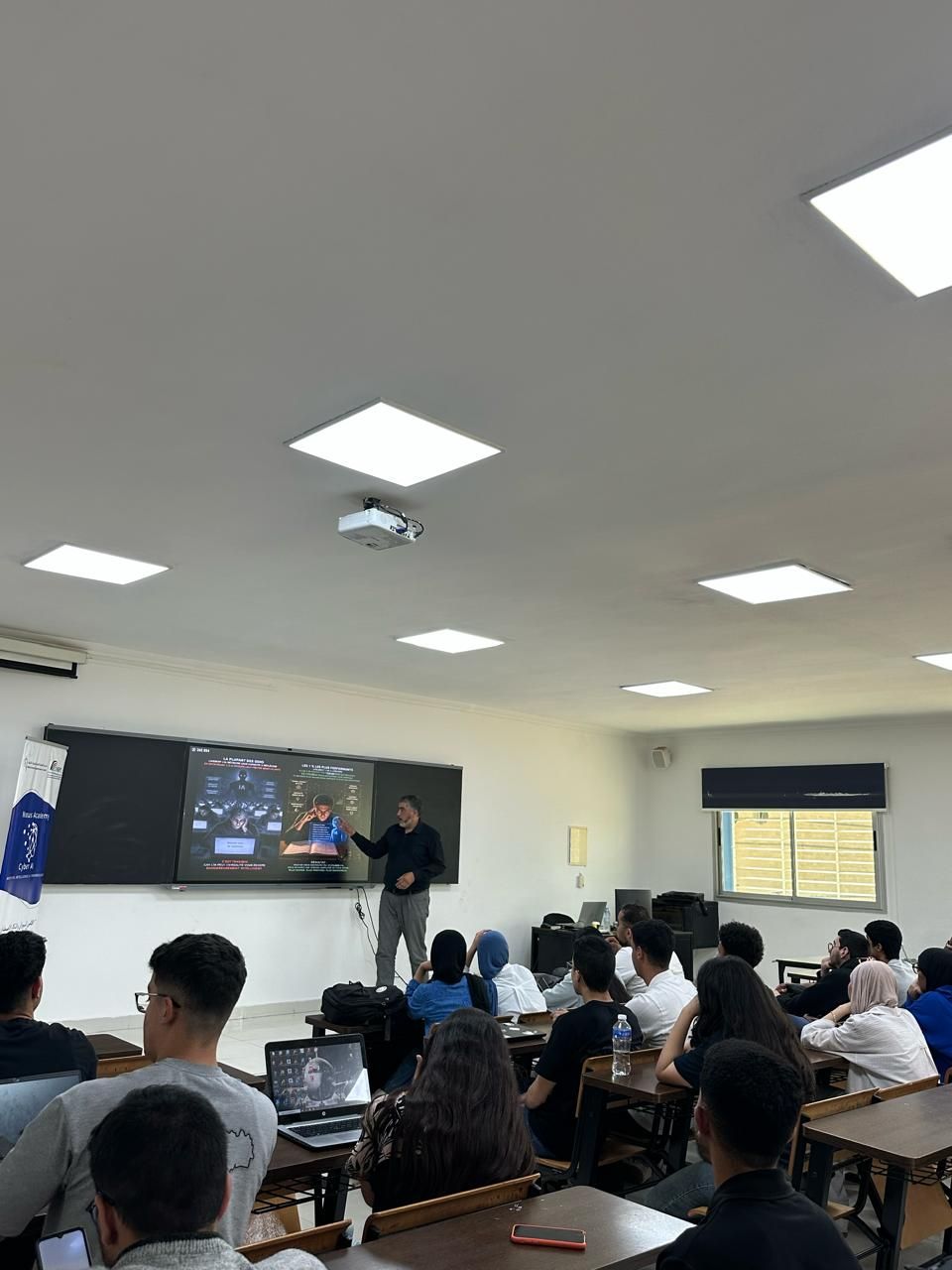
Organized through a collaborative framework involving ENSA Kenitra, the Association of Information Systems Users in Morocco (AUSIM), and the Moroccan Center for Research and Polytechnic Innovation (CMRPI), and delivered through Nexus CyberAI Academy, the masterclass primarily targeted engineering students. Led by Fahd Meski, the session created a practical learning environment in which participants could move beyond the everyday use of generative AI and examine methods for interacting with these systems more effectively.
The technical scope covered Prompt Engineering, Large Language Models (LLMs), Few-Shot Prompting, AI Agents, and emerging approaches to artificial intelligence. Participants explored how prompts can be structured to communicate a task more clearly to a generative AI model. Few-Shot Prompting introduced the use of examples to guide the model towards the expected type of response, while the discussion of LLMs and AI Agents placed these techniques within the broader development of contemporary generative AI technologies.
The masterclass also addressed the importance of context. Effective interaction with generative AI is not limited to asking a question; the information provided around that question can help the model interpret what is expected. Participants therefore examined how instructions, relevant background and examples can contribute to more purposeful interactions with AI. This dimension extended the discussion from the construction of individual prompts to the role of Context Engineering in providing AI systems with the information needed to approach a given task.
Learning was supported through concrete examples, practical exchanges and discussion. Rather than presenting Prompt Engineering only as a theoretical concept, the session enabled participants to examine good practices for communicating with generative AI and to consider their application in data, development and digital innovation, as well as in academic and professional environments.
For the participating students, the main gain was a deeper understanding of how generative AI can be approached deliberately rather than used simply as an immediate source of answers. They explored the relationship between the task being requested, the instructions given, the context supplied, and the examples used to guide an AI model. Through this approach, participants deepened their understanding of generative AI technologies and became familiar with practical methods for structuring their interactions with them.
The learning shift was therefore from using generative AI to examining how that use can be structured. The masterclass did not report a formal assessment of student performance, so its contribution should not be expressed as a measured improvement in skills. What it demonstrably provided was exposure to methods, concepts, and good practices that broadened participants’ understanding of how contemporary generative AI systems can be approached and used.
The initiative was supported by Pr. Youssef Bentaleb, President of CMRPI, and Pr. Mehdia Ajana El Khaddar, Coordinator of Nexus Academy, alongside the participating institutional teams. By bringing together prompting, context, LLMs, few-shot prompting, and AI Agents within one practical learning setting, “The Art of AI Prompting” connected engineering education with emerging digital practices and provided students with a broader framework for approaching generative AI in their academic learning and future professional environments.