
Event: 9–10 October 2025
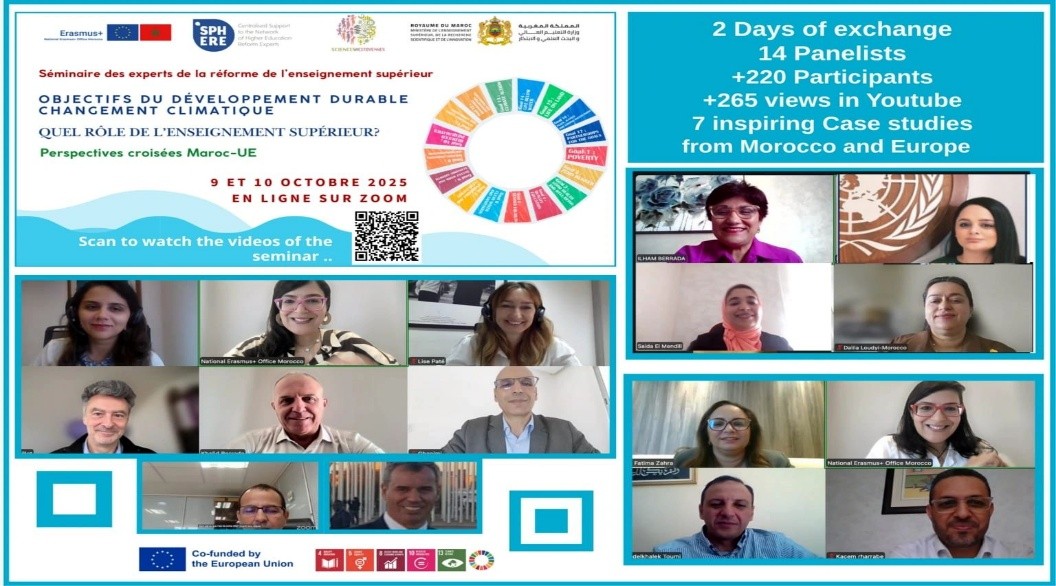
Sustainable development is no longer a distant objective discussed in policy documents alone; it has become a shared responsibility that universities are increasingly called upon to translate into action. In this spirit, the Erasmus+ National Office Morocco, in collaboration with the Ministry of Higher Education, Scientific Research and Innovation, organized the national seminar “Sustainable Development Goals and Climate Change: What Role for Higher Education ?”, held online on 9–10 October 2025. The event brought together Moroccan and European experts around a common question: how can higher education meaningfully contribute to building a more sustainable and resilient future ?
Conceived as a space for dialogue, reflection, and assessment, the seminar responded to a national context marked by profound reforms in education, research, and sustainable development. These reforms, anchored in Morocco’s New Model of Development, the Strategic Vision for Education 2015–2030, and the evolving legal framework governing higher education, position universities as central actors in promoting inclusion, innovation, and environmental responsibility. The seminar thus provided a timely opportunity to examine how these orientations can be translated into concrete institutional practices.
Over two days of exchange, the seminar featured 14 thematic panel sessions and gathered more than 220 participants from across the higher education ecosystem. Discussions addressed the integration of the Sustainable Development Goals into university missions, comparative international experiences, tools for measuring impact, sustainable campus development, governance models, and the role of research and innovation in responding to climate challenges. Beyond formal presentations, the seminar functioned as a collective learning space where experiences were shared, questioned, and enriched.
The diversity of participants, university leaders, senior ministry officials, vocational training representatives, sustainability experts, Erasmus+ project coordinators, researchers, members of the HERE–Morocco network, and doctoral students contributed to the depth of the dialogue. This plurality of perspectives allowed for a comprehensive reading of both achievements and challenges, reinforcing the idea that sustainable development in higher education requires coordinated and long-term commitment.
Within this national and international exchange, Ibn Tofail University, Kenitra, contributed its institutional experience through a case study presented by Saida El Mendili, Professor and Director of the Scientific Production Support Center. Entitled “Training, Practicing, and Innovating around the SDGs: The Model of Ibn Tofail University,” the presentation illustrated how sustainability at the university is approached as a transversal process embedded across education, research, campus life, and governance, rather than a set of isolated actions.
The case study highlighted initiatives that have shaped the university’s sustainable development trajectory, particularly in areas such as water resource management, waste management and reduction, energy efficiency, and inclusive education. These initiatives reflect a holistic vision in which environmental responsibility, social inclusion, and academic quality reinforce one another. Emphasis was placed on the importance of institutional coordination, continuous monitoring, and evidence-based assessment in ensuring that sustainability efforts produce lasting impact.
Throughout the seminar, participants repeatedly emphasized the need to move from strategic alignment to practical implementation. Discussions focused on how universities can operationalize sustainability through curricula, research agendas, governance structures, and campus practices, while developing indicators that allow institutions to assess progress and guide decision-making. In this sense, the seminar served not only as a platform for sharing experiences but also as a moment of collective self-assessment and renewed motivation.
The exchanges concluded with a shared understanding that higher education has a decisive role to play in addressing climate and sustainability challenges. By fostering dialogue, encouraging critical reflection, and showcasing concrete institutional experiences, the Erasmus+ seminar strengthened a collective commitment to action. For Ibn Tofail University, participation in this national platform reaffirmed the value of sustained effort and integrated governance in translating global sustainability goals into tangible outcomes. More broadly, the seminar illustrated how universities, when working together, can become powerful drivers of sustainable change and contributors to a more inclusive and resilient future.