Event : 11 June, 2026
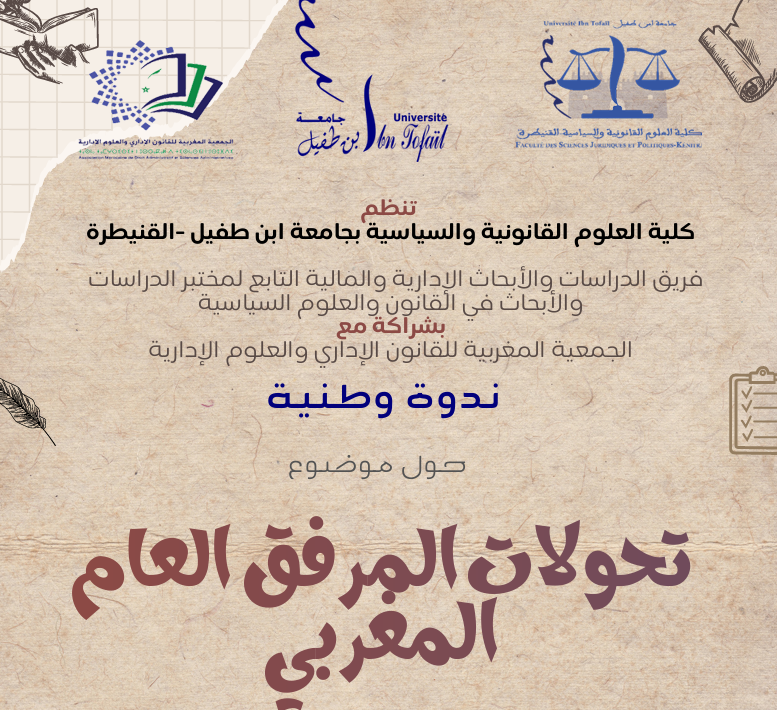
The Faculty of Legal and Political Sciences (FSJP) of Ibn Tofail University, in partnership with the Moroccan Association of Administrative Law and Administrative Sciences, organized a national conference on “Transformations in the Moroccan Public Service” on 11 June 2026 at the Institute of Sports Professions of Ibn Tofail University. The event brought together academics, researchers and specialists to examine the evolution of the Moroccan public service and the legal, institutional and administrative transformations shaping its current and future development.
The conference addressed the concept of the public service from both its institutional and functional dimensions. Discussions highlighted the role of public services in meeting citizens’ needs and serving the public interest, while also examining the legal framework governing their organization, operation and continuity. Particular attention was given to the evolving relationship between the administration, public interest and the requirements of transparency, accountability and good governance.
A central contribution to the conference was delivered by Dr. Ahmed Aajoun, Professor of Higher Education at the Faculty of Legal and Political Sciences in Kenitra, Deputy Dean of the Faculty, and President of the Moroccan Association of Administrative Law and Administrative Sciences. His presentation addressed the transformations of the Moroccan public service, examining its historical development and the major legal and institutional changes that have shaped its current configuration.
The presentation highlighted the historical evolution of the Moroccan public service, from the establishment of traditional administrative and public-service structures during the Protectorate period to the development of new public institutions following independence. It also examined the expansion and diversification of public services in response to changing social and economic needs, as well as the progressive transformation of the role of the State and public administration.
Particular emphasis was placed on the changes introduced following the 2011 Constitution, which marked an important stage in the development of the Moroccan public service by strengthening principles related to good governance, quality of public services, accountability and citizens’ rights. The discussion also referred to the growing importance of the legal framework governing public services, including legislation relating to the Charter of Public Services, the simplification of administrative procedures and formalities, access to information, and the modernization and decentralization of administration.
The conference further explored the impact of digital transformation on the public service. The development of digital administration and the increasing use of digital technologies are reshaping the way public services are delivered, while creating new expectations regarding accessibility, efficiency, transparency and the speed of administrative procedures. In this context, the discussions raised questions about the capacity of the current legal and institutional framework to accompany these transformations and ensure that digitalization contributes effectively to improving the quality of public services.
The event also considered the need to place citizens and users of public services at the centre of administrative reform. Ensuring continuity of service, respecting transparency and fairness, improving the quality of administrative procedures, and facilitating access to information were highlighted as important elements in strengthening confidence in public institutions and enhancing the effectiveness of public services.
Through this national conference, the Faculty of Legal and Political Sciences of Ibn Tofail University and the Moroccan Association of Administrative Law and Administrative Sciences provided an academic platform for examining the major transformations affecting the Moroccan public service. The event contributed to strengthening scientific debate on administrative reform and to exploring how public institutions can respond to contemporary social, legal, technological and economic challenges.
The conference makes a direct contribution to Peace, Justice and Strong Institutions, particularly through its focus on effective, accountable and transparent public institutions, administrative governance and the modernization of public services. Its discussions on citizens’ access to information, administrative simplification, institutional accountability and the quality and continuity of public services are closely aligned with the objectives of strengthening effective and responsive institutions.The event also contributes to Quality Education by promoting academic research, knowledge sharing and scientific debate. In addition, the partnership between the Faculty of Legal and Political Sciences and the Moroccan Association of Administrative Law and Administrative Sciences supports Partnerships for the Goals, by strengthening cooperation between academic and professional/scientific institutions.