Event: 1 November 2026
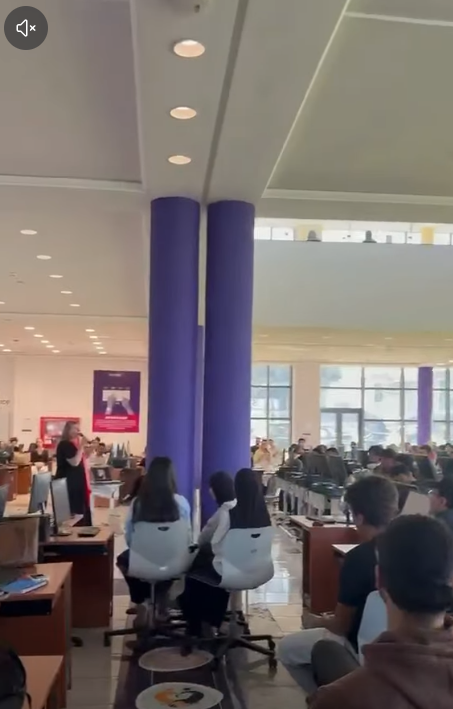
On 1 November 2026, Ibn Tofail University, through its Centre of Excellence in Design and Applied Arts, organised an interactive workshop titled Digital Art for the Environment and Sustainable Cities, in partnership with the French Institute in Morocco. The workshop engaged students in exploring climate change’s impact on urban environments through designing future cities, developing environmentally responsible architectural proposals, and creating audio podcasts.
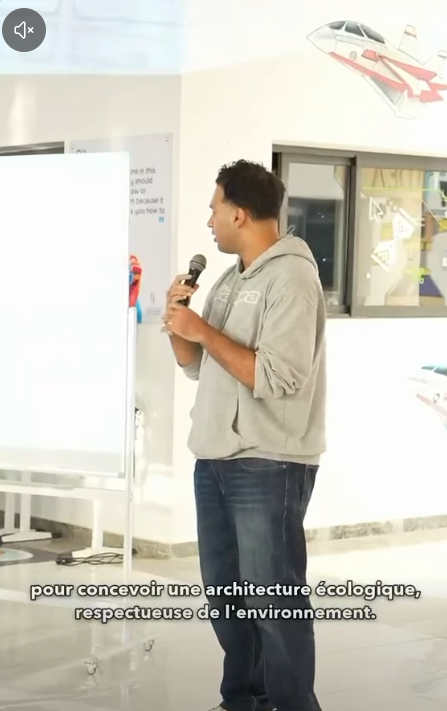
Cécile Palusinski, Director of NUMERED, a French organisation specialising in cultural training, consultancy, and immersive creative practices, facilitated the two-hour session. Combining visual design with sound production, the workshop introduced students to creative approaches for examining environmental challenges and communicating possible solutions. Its practical format placed student participation and collaborative work at the centre of the activities.
The main exercise challenged participants to imagine cities capable of responding to the consequences of climate change. Working in groups, students considered how environmental concerns could be incorporated into future urban development, particularly through ecological architecture. They used their imagination and design skills to propose alternative urban spaces that take account of environmental protection and sustainability.
Students translated their proposals into architectural drawings, using visual representations to communicate their ideas for future cities. The design activity required them to consider the relationship between the built environment and ecological concerns while applying creative thinking to their proposals. Group discussions and shared design tasks allowed participants to bring together their individual contributions into collective projects.
Sound creation formed another component of the workshop. Students developed audio podcasts addressing ecological issues and their visions of future urban environments. By combining drawings with sound-based content, they explored how different forms of artistic communication could present environmental ideas and make architectural concepts more accessible to audiences.
The workshop concluded with drawings, proposals for future cities and audio content developed during the session. Despite the limited time available, the participating groups completed the assigned activities and produced work reflecting their understanding of environmental challenges. Cécile Palusinski highlighted the students’ engagement, their attention to the workshop instructions and the quality of the visual and sound-based contributions produced within two hours.
The approach adopted during the workshop is also reflected in Palusinski’s wider artistic practice. Together with visual artist Elsa Mroziewicz, she developed Floating Cities, an international project combining digital art, augmented reality and sound creation to explore ecological challenges through imaginary floating cities. The project examines possible responses to environmental pressures, particularly those affecting urban and coastal environments, through architectural imagination and artistic expression.
The workshop brought together environmental education, creative design and digital communication within the framework of cooperation between Ibn Tofail University and the French Institute in Morocco. Through collaborative drawings, ecological architectural proposals and audio podcasts, students applied artistic skills to questions of climate adaptation and sustainable urban development, producing work that connected creative practice with contemporary environmental challenges.