Event: 2 May 2026
English plays an important role in academic communication and international exchange, enabling students to access knowledge, share ideas, and engage with people from different backgrounds. Using the language effectively, however, involves more than linguistic proficiency. It also requires organizing ideas, developing clear arguments, and communicating them confidently to an audience. Public speaking provides a practical setting to develop and apply these skills.
The English-Speaking Union (ESU) promotes these abilities through educational programs and competitions centered on spoken communication. In Morocco, its National Public Speaking Contest allows university students to address topics of wider relevance and communicate their ideas in English with clarity and conviction. Organized through regional and national stages, the competition also selects Morocco’s representative for the ESU’s International Public Speaking Competition in London.
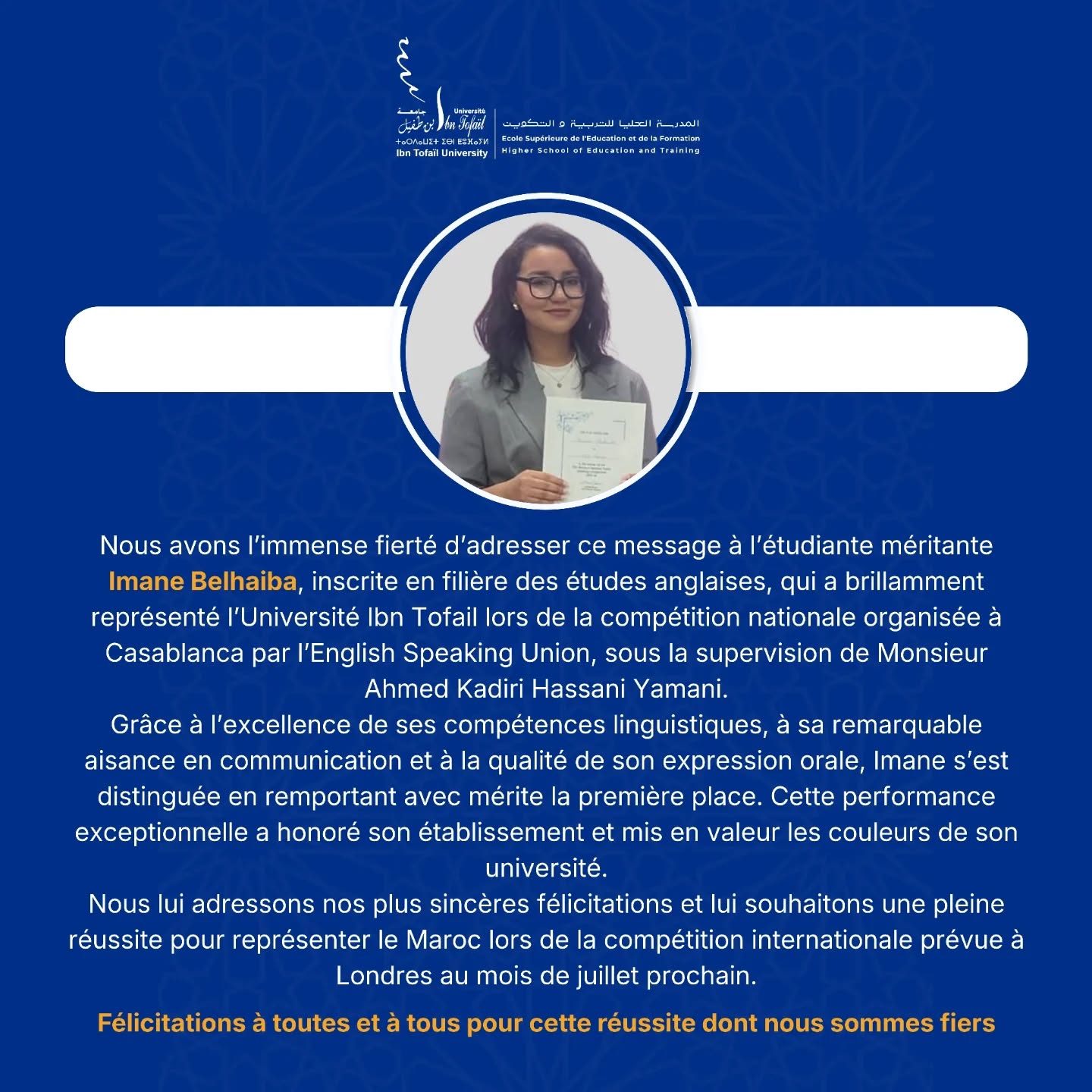
In the 2026 edition, Imane Belhaiba, an English studies student at Ibn Tofail University, won first place in the national competition held in Casablanca. She represented the university under the supervision of Professor Ahmed Kadiri Hassani Yamani of the Higher School of Education and Training (ESEF). Her victory qualified her as Morocco’s representative for the international stage.
The 2026 edition marked the return of the National Public Speaking Contest in Morocco following a hiatus since 2019. The selection process began with regional competitions organized across the country between 15 March and 15 April 2026. Students selected through these qualifying rounds advanced to the national stage, where the Moroccan representative for the international competition was chosen.
At the regional stage, participants addressed the theme “The power to question is the basis of all human progress,” attributed to Indira Gandhi. The theme encouraged students to examine an issue of broad relevance, develop their perspectives, and communicate them through a structured speech in English. This approach placed language skills in a practical context while encouraging students to organize their ideas, think critically, and communicate effectively before an audience.
By securing first place nationally, Belhaiba qualified for the International Public Speaking Competition (IPSC) in London. Organized by the English-Speaking Union, the IPSC brings together young speakers selected through national competitions in different countries. The program combines public speaking with learning and cultural exchange, allowing participants to communicate their ideas and engage with perspectives from different cultural contexts.
Belhaiba’s national success demonstrates the practical application of skills developed through higher education. Her achievement connects English-language learning with public speaking, critical thinking, and intercultural communication, while extending student engagement from the university environment to an international academic and cultural context.