
Event : 30 – 31 May 2025
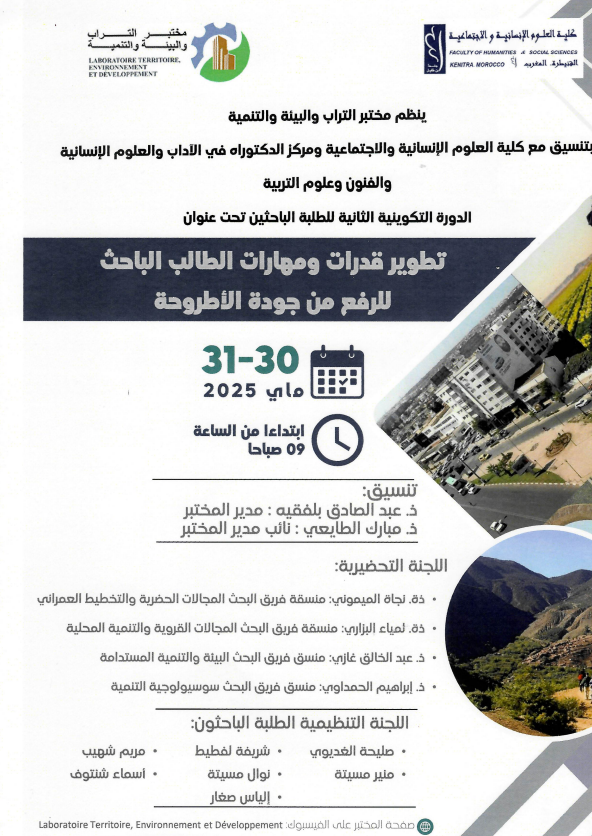
On May 30–31, 2025, the Laboratory of Territory, Environment and Development, in coordination with the Faculty of Humanities and Social Sciences and the Doctoral Center of Arts, Humanities, Social Sciences, and Education at Ibn Tofaïl university, organized the Second Training Session for Doctoral Students under the theme: “Developing the Capacities and Skills of Doctoral Students to Improve the Quality of the Dissertation.”
Conceived as a structured academic framework, the initiative focused on strengthening dissertation design, analytical coherence, and scientific production. From the outset, emphasis was placed on problem formulation, hypothesis construction, methodological alignment, and adherence to academic standards consistent with national and international expectations.
The first scientific session addressed academic publication and editorial standards. Participants were introduced to the role of the Scientific Production Support Center in facilitating publication processes. Discussions covered writing techniques, peer-review criteria, journal requirements, and the transformation of thesis chapters into indexed scientific articlesthereby enhancing research visibility and impact.
The thematic presentations showcased doctoral work on rural development, water accessibility, mountain agriculture in the Middle Atlas, territorial governance, and urban dynamics in the Gharb region. These contributions demonstrated alignment with pressing socio-territorial challenges. Structured exchanges following each presentation enabled critical feedback and refinement of methodological approaches.
The second day was dedicated to intensive methodological workshops. Doctoral candidates worked on delimiting research topics, articulating research questions, selecting appropriate methods, applying analytical indicators, and integrating statistical considerations into their designs. Particular attention was given to fieldwork practices in sociology and geography, including data collection, empirical structuring, and interpretation of findings.
What distinguished this edition was its integrated design. Publication guidance, methodological training, and research presentation were articulated as interconnected stages within a unified academic pathway from conceptualization to dissemination.
The session provided participants with practical tools to enhance the structure, analytical depth, and scholarly contribution of their dissertations. By investing in structured doctoral support, the Laboratory of Territory, Environment and Development contributes to consolidating a research environment grounded in methodological discipline, scientific productivity, and societal relevance.
This initiative aligns directly with United Nations Sustainable Development Goal 4 (Quality Education), particularly its emphasis on ensuring inclusive and equitable quality education and promoting lifelong learning opportunities for all. By strengthening doctoral supervision, enhancing methodological competencies, and supporting scientific publication, the training contributes to improving the quality and relevance of higher education. It fosters advanced research skills, critical thinking, and knowledge production capacities that are essential for sustainable development. Moreover, by aligning doctoral research with societal challenges, the initiative reinforces the role of universities as drivers of innovation, evidence-based policy, and long-term socio-economic progress.